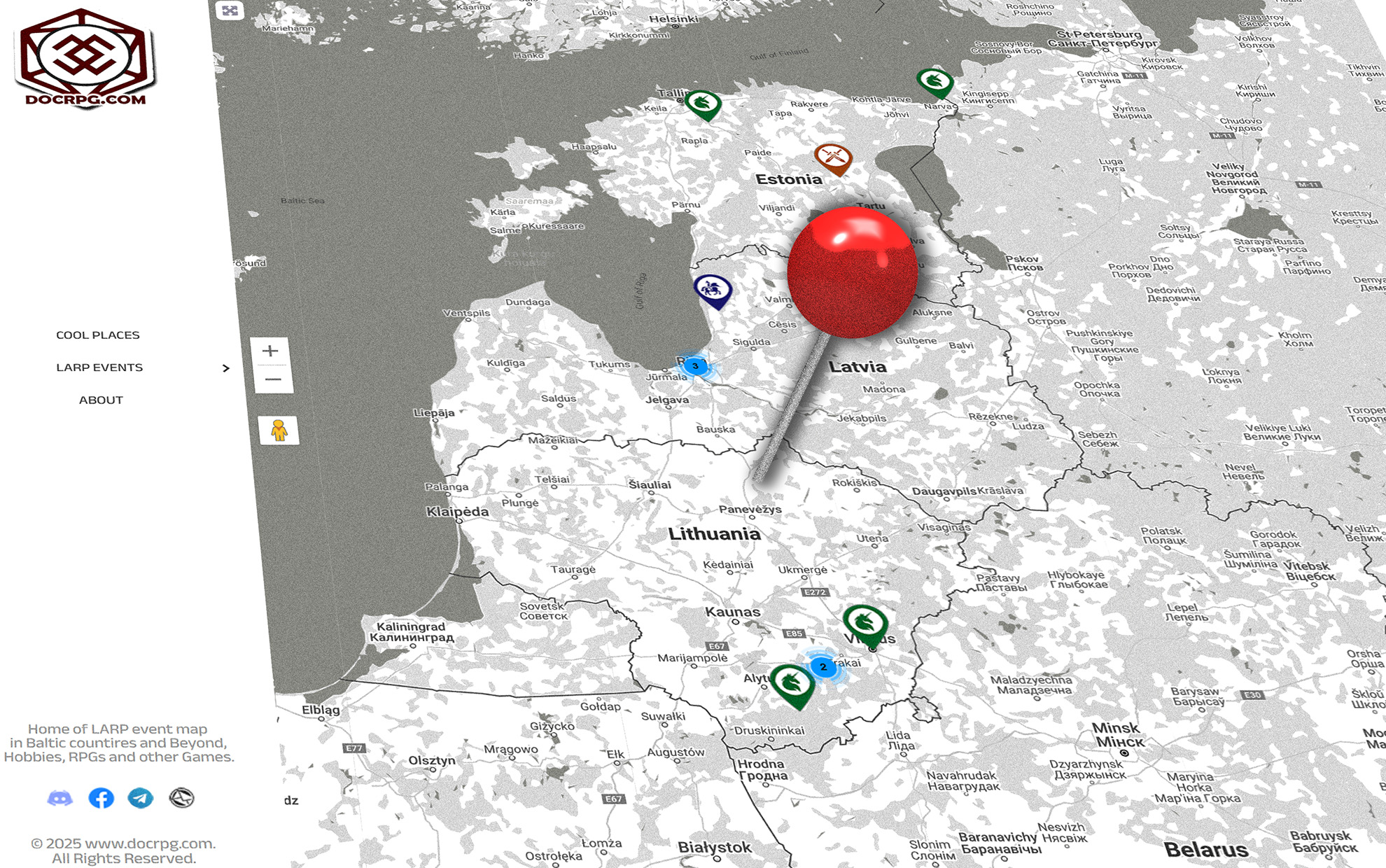
It's not like the LARP community lacks energy or creativity. On the contrary. But like many niche hobbies, it often struggles with visibility, cohesion, and accessibility in the noisy digital landscape. Communities form, grow, and usually vanish into digital silence, not due to lack of passion but because modern platforms are bound to the constant flow of content and don’t serve the needs of volunteer-driven subcultures.
It might seem like everything's fine and dandy, but even when you know what you're looking for, it can seem maddeningly elusive. And if you're new to LARP? The barrier feels even higher—like trying to enter a secret society whose doors are hidden behind outdated hyperlinks, abandoned web spaces frozen in time and dozens of chats, groups and forums on every imaginable platform. Just to keep track of everything I currently monitor 19 groups and it's just on a single platform.
The struggle of keeping your hand on the pulse
The constant Lack of Clarity
I'm ready to bet that the most likely way to discover a LARP game in the Baltics is through a friend-of-a-friend pointing you to a Facebook group or a Telegram chat. Let’s say you get lucky—you’ve made it inside. What greets you is a whirlwind of conversation, possibly in a language you're not fluent in. Somewhere in the pinned messages or a buried Google Doc, the lore is hidden. Maybe there's a link to the rules. Maybe a registration form.
In theory, we’re more connected than ever. In practice, vital information is scattered across threads, platforms, and chats—often buried under weeks of unrelated discussion. Even for active members, this fragmentation is frustrating.
I once tried to show information about a game to a friend, and it was so convoluted that I ended up counting the steps needed just to begin the search. Between registering for different platforms, logging in, finding the right group, joining it, and then digging through its archives, it often takes anywhere from three to six steps—before you're even close to the actual information. There’s no malicious intent behind this maze—just the reality of grassroots communities trying to function without centralized tools.
The Baltic LARP community is, at its heart, incredibly welcoming. Players are eager to share stories, invite newcomers, and collaborate across borders. But the languages that define our everyday lives—Estonian, Latvian, Lithuanian, Russian, English—often become walls when it comes to finding and sharing information. Announcements are missed. Signups are hard to find. Rules are left untranslated. Communities grow in parallel, rather than together.
These divides are reinforced by the tools we use. Estonian groups might live on Facebook; Latvian ones might favor Telegram; Lithuanians might organize in Discord. There’s no consistent place to look, no shared digital tavern where word of mouth can pass freely across borders. On one hand, Russian-speaking LARPers across the Baltics form a unified subculture, but often struggle with the same problem as everyone else: finding and sharing information about mutual events.
This fragmentation isn’t just inconvenient—it’s a loss. A loss of potential players, collaborations, and new friendships.
Borders Without Signs: Language and Regional Barriers
What can be done about all that?
I believe the Baltic LARP scene doesn’t need to be fragmented. It’s already rich, friendly, and open-hearted. This website is here to make LARP in the Baltics easier to find and join. It starts in English, with Russian support coming soon—for all those who’ve left their homes and still struggle with language barriers. I’m building a clear, searchable map of upcoming events.
Each listing will answer key questions at a glance:
What’s the genre?
Where and when is it?
What languages are supported?
How much does it cost?
How many people?
Where are the links?
How to navigate there?
Download much needed files from one place.
Share the event quickly with a friend.
But it’s not just events. Clubs, communities, and online spaces will also be listed and organized, so you can find your people—not just games. And this is only the beginning. I’ll keep adding features as the needs grow.
The goal is simple: make LARP, Reenactment, and other hobbyist events more open, more connected, and easier for everyone.